NVIDIA is turning to artificial intelligence and advanced optimization to tackle one of the biggest challenges behind the AI boom: how to allocate limited hardware across a massive global supply chain.
The company is combining Palantir Foundry, NVIDIA cuOpt, and Nemotron AI models to help automate supply chain allocation decisions across manufacturing sites. The goal is straightforward but difficult to achieve at scale: get the right components to the right factory at the right time while keeping production moving and minimizing delays.
NVIDIA tracks this process from wafer-out to first token, measuring how long it takes for semiconductor output to become a fully operational AI system.
This measurement covers two critical stages. Time-to-rack measures the journey from chip production to an assembled data center system, while time-to-token extends the process to include power, cooling, networking, and software readiness.
NVIDIA’s AI Hardware Supply Chain Is Becoming More Complex
The scale of NVIDIA’s hardware ecosystem makes supply chain planning increasingly difficult.
A single Grace Blackwell NVL72 rack contains 18 compute trays. Each tray requires two Grace CPUs, four Blackwell GPUs, and 32 HBM3e memory packages. Those components come from a huge network of suppliers, OEMs, and contract design partners.
The challenge is expected to grow even further with NVIDIA’s Vera Rubin architecture. Its supporting supply chain is being built at roughly twice the scale of the network used for Grace Blackwell.
Every production decision therefore depends on the availability of multiple components arriving through different channels, including direct inventory, consignment stock, and external suppliers.
A delay in just one critical component can hold up an otherwise ready shipment.
This creates additional Time of Ownership (TOO), NVIDIA’s measurement for the period between a facility receiving materials and completed sub-assemblies leaving the facility.
To keep production aligned with demand, NVIDIA revisits factory allocations every week using rolling two-quarter planning windows. The process considers everything from component availability and factory capacity to customer delivery commitments.
Palantir Foundry Becomes the Supply Chain Intelligence Layer
To manage these interconnected decisions, NVIDIA developed a Digital Supply Chain Intelligence command center using Palantir Foundry.
The platform uses Palantir’s Ontology to connect operational information across the supply chain. Facilities, inventory, supplier commitments, components, and production requirements can be represented as linked objects rather than isolated datasets.
This gives NVIDIA a unified operational view of its manufacturing network.
But visibility is only part of the problem. The bigger question is what the company should actually do with that information.
That’s where NVIDIA cuOpt comes into the picture.
cuOpt Turns Supply Chain Data Into Allocation Decisions
NVIDIA cuOpt is a GPU-accelerated optimization library designed to solve complex decision-making problems.
For NVIDIA’s supply chain, cuOpt can model allocation as a mixed-integer linear programming (MILP) problem. The objective is to minimize Time of Ownership while accounting for constraints across different levels of the bill of materials.
Instead of simply generating a production schedule, the optimization system can expose the constraints preventing that schedule from being achieved.
For example, a region may have enough components but not enough assembly capacity. Another facility may have available production capacity but lack critical memory components.
These relationships make traditional supply chain planning difficult to manage manually.
With cuOpt, NVIDIA can evaluate these constraints together and identify how factory resources and components should be allocated.
Why Mathematical Optimization Alone Wasn’t Enough
Even the most sophisticated optimization model cannot easily understand every factor influencing a real-world supply chain.
Human planners routinely use information that does not fit neatly into structured databases. Supplier phone calls, emails, weather conditions, geopolitical developments, and partner communications can all influence production decisions.
NVIDIA therefore added another layer of intelligence using Nemotron 3.5 Lightning.
The company post-trained the open-weight mixture-of-experts model to better understand qualitative operational information and support supply chain allocation decisions.
The model contains 30 billion total parameters, with approximately three billion active parameters during each forward pass.
NVIDIA’s training workflow combines several tools, including NeMo Anonymizer, NeMo Data Designer, and NeMo AutoModel. Sensitive operational information is anonymized, training examples are balanced with synthetic disruption scenarios, and LoRA-based fine-tuning is applied without changing the model’s base weights.
Palantir Autopilot is then used to support data lineage, model tracking, and recommendation delivery.
Domain-Specific AI Delivers Better Results
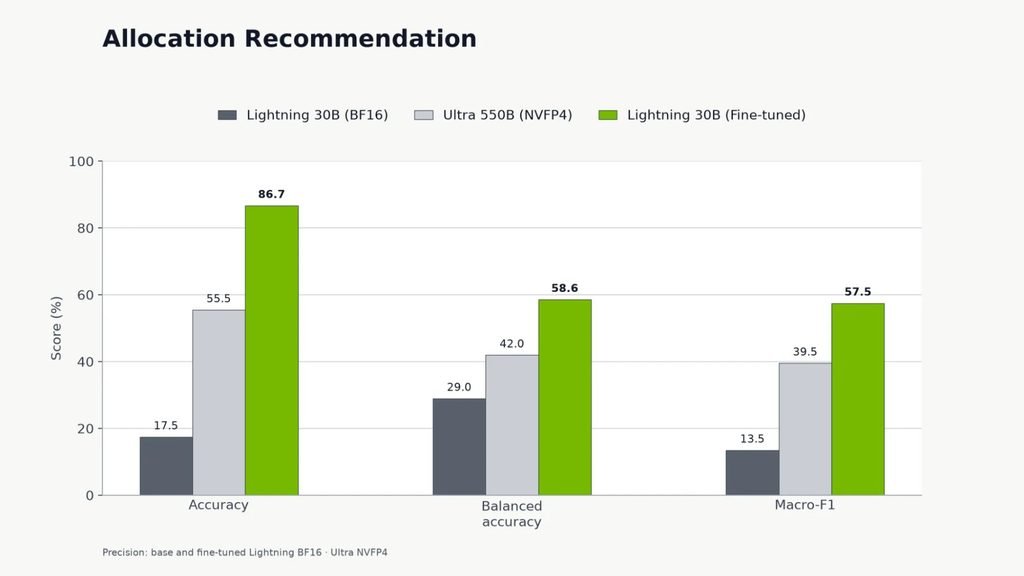
The results suggest that a smaller, domain-specific AI model can outperform a larger general model when applied to a specialized operational problem.
When tested against historical allocation records, the post-trained Nemotron 3.5 Lightning model reached 86.7% decision accuracy.
That compared with:
- 55.5% for Nemotron 3 Ultra
- 17.5% for the untuned Lightning model
- 58.6% balanced accuracy for the post-trained model
- 57.5% macro-F1 score for the post-trained model
Nemotron 3 Ultra recorded 42% balanced accuracy and a 39.5% macro-F1 score.
The fine-tuning process was also relatively lightweight, completing within minutes on two NVIDIA B200 GPUs.
The findings highlight an important trend in enterprise AI: specialized models trained on domain-specific operational data can be more useful than larger models that lack context about a particular business problem.
Creating a Continuous AI Supply Chain Feedback Loop
NVIDIA is not treating AI recommendations as a one-time planning exercise.
Operational decisions, planner adjustments, manual overrides, and actual factory results are continuously fed back into the Palantir Ontology.
This creates a feedback loop between AI recommendations and real-world supply chain outcomes.
Over time, this information can help NVIDIA understand which allocation decisions work, where planners intervene, and how actual factory performance differs from predictions.
The company plans to use these records to build preference pairs for future reinforcement learning systems. Recommendations can then be evaluated based on factors such as allocation precision, policy compliance, and the quality of supporting evidence.
Importantly, production models remain separated from live and uncontrolled retraining environments.
NVIDIA’s Supply Chain Strategy Goes Beyond Visibility
NVIDIA’s approach illustrates how the next generation of supply chain technology is moving beyond dashboards and forecasting.
Traditional supply chain systems primarily answer questions such as what is available, where inventory is located, and when an order might arrive.
NVIDIA’s approach is aimed at a more complex question:
What should the supply chain do next?
By combining Palantir Foundry’s operational data model, cuOpt’s mathematical optimization capabilities, and Nemotron’s ability to interpret qualitative information, NVIDIA is building an AI-powered decision layer for its hardware manufacturing network.
As AI infrastructure demand continues to grow, this type of technology could become increasingly important. The competitive advantage may not simply come from producing more GPUs, but from determining how efficiently those GPUs, components, factories, and production capacity can be coordinated across the global supply chain.